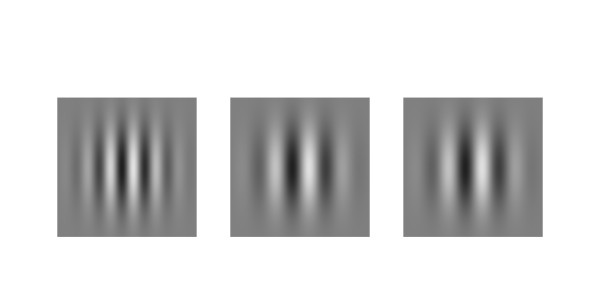
A Gabor patch: sinusoidal gratings modulated by a Gaussian envelope, designed to optimally activate V1 neurons.
What Are Gabor Patches?
A Gabor patch is a mathematical pattern—specifically, a sinusoidal grating modulated by a Gaussian envelope—that has become the gold standard stimulus in vision neuroscience. Think of it as a striped pattern that gradually fades into the background. While it may look simple, its mathematical structure is precisely engineered to match how your brain's visual cortex processes information.
You might wonder: why these specific patterns? The answer lies in decades of neuroscience research showing that Gabor patches are the optimal stimulus for activating neurons in your primary visual cortex (V1)—the foundation of all visual processing.
💡 Key Insight
Gabor patches efficiently activate V1 neurons (the foundation of vision), allow precise difficulty calibration, target specific aspects of visual processing, and create optimal conditions for neuroplastic strengthening.
The Nobel Prize-Winning Physics Behind Gabor Patches
The story begins with Dennis Gabor, a Hungarian-British physicist who won the 1971 Nobel Prize in Physics for his invention of holography. But before that revolutionary work, Gabor made another profound contribution: he discovered the fundamental "quantum" of information in signal processing.
In his 1946 paper "Theory of Communication," Gabor applied the tools of Fourier analysis to signals, proposing a fundamental unit of information he called a "logon"—representing a signal confined to a minimal area in the time-frequency plane. The mathematical function that embodies this principle? A sinusoidal wave modulated by a Gaussian function. This is the Gabor function.
🏆 The Uncertainty Principle of Vision
Gabor recognized a fundamental uncertainty principle in signal processing, similar to Heisenberg's principle in quantum mechanics: the more precisely a signal is located in time, the more spread out and uncertain its frequency content becomes, and vice versa.
The Gabor function is the mathematical solution that achieves optimal joint localization in both domains simultaneously. This same principle applies to vision: Gabor patches are the most tightly localized patterns possible in both spatial location and spatial frequency—making them the perfect match for how V1 neurons are organized.
Why This Matters for Vision Training
V1 neurons in your brain function as biological Gabor filters. Each neuron has a "receptive field"—a specific region of your visual field it monitors—and responds to specific patterns within that region. The response properties of these neurons (orientation, spatial frequency, location) are described by functions that are mathematically nearly identical to Gabor functions.
This isn't coincidence—it's optimal engineering. Just as Gabor functions represent the fundamental "atoms" of signal processing, V1 neurons represent the fundamental units of visual processing. When you train with Gabor patches, you're using stimuli that speak the native mathematical language of your visual cortex.
Why Gabor Patches Are the "Gold Standard"
Your brain processes vision in stages, starting with the primary visual cortex (V1). V1 neurons—often called "simple cells"—don't respond to complex objects like faces or letters. Instead, they're exquisitely tuned feature detectors, each programmed to fire when it detects specific visual properties:
- Orientation: Each neuron responds to lines at specific angles (horizontal, vertical, diagonal)
- Spatial frequency: Some neurons detect fine details, others respond to coarse patterns
- Contrast: Neurons are sensitive to the difference between light and dark
- Location: Each neuron has a specific receptive field in your visual space
Gabor patches are the optimal stimulus because their mathematical structure perfectly matches the receptive field properties of V1 neurons. It's like speaking the native language of your visual cortex—these patterns activate the foundational processing units with maximum efficiency.
⭐ Research Validation
Over 20 years of peer-reviewed research published in journals like Proceedings of the National Academy of Sciences and Vision Research have validated Gabor patches as the optimal training stimulus for improving visual processing.
How Gabor Patches Train Your Brain
When you train with Gabor patches in Visionary, you're not just looking at random patterns. You're engaging in a precisely calibrated neuroplastic training protocol:
1. Threshold Stimulation
Patterns are presented at threshold difficulty—just barely visible. This forces your visual cortex to work hard, creating optimal conditions for neuroplastic change.
2. Neural Strengthening
Repeated practice at threshold difficulty strengthens the neural connections responsible for processing fine visual detail and contrast.
3. Adaptive Difficulty
Our 3-down, 1-up staircase algorithm adjusts difficulty in real-time, maintaining that crucial threshold level as your brain improves.
4. Transfer to Real-World
Improvements in processing Gabor patches transfer to real-world tasks like reading, demonstrating genuine visual system enhancement.
Why Not Just Use Letters or Text?
This is a great question that many people ask. While Visionary does include letter and text-based training, Gabor patches serve a specific purpose:
Gabor patches = Weight training for your visual cortex. They isolate and strengthen specific neural pathways with maximum efficiency. They're the foundational exercise that builds core visual processing capabilities.
Letter/text tasks = The sport you're training for. These are ecologically valid tasks that let you apply your improved visual processing to real-world activities like reading.
Think of it like physical training: you do squats and deadlifts (isolated strengthening) to get better at basketball (real-world performance). Both are important, and both work together.
🔬 Scientific Precision
Gabor patches allow researchers to precisely control orientation, spatial frequency, contrast, and phase—parameters that can't be controlled with real-world stimuli. This precision is crucial for effective training.
The Research Behind Gabor Patch Training
The use of Gabor patches in perceptual learning isn't just theoretical—it's backed by rigorous clinical evidence:
- Polat et al. (2004, PNAS): Demonstrated that Gabor patch training produces lasting improvements in visual acuity by strengthening V1 processing
- UC Berkeley (2012): Over 90% of presbyopic participants achieved newspaper reading without glasses after 3 months of Gabor patch training
- Levi & Li (2009): Benefits from Gabor patch training persist 12+ months after training ends, showing genuine neural plasticity
These studies consistently show that Gabor patch training creates measurable, lasting improvements in visual function—not placebo effects, but real changes in how your brain processes visual information.
How Visionary Uses Gabor Patches
In your daily training sessions, you'll encounter Gabor patches in various exercises:
- Orientation discrimination: Identifying whether patches are tilted left or right
- Contrast detection: Spotting low-contrast patterns against backgrounds
- Spatial frequency tasks: Distinguishing between fine and coarse patterns
- Lateral masking challenges: Identifying target patches surrounded by flankers
Each task is scientifically designed to target specific aspects of visual processing that are compromised in presbyopia. The combination of these exercises creates a comprehensive training protocol that improves your brain's ability to interpret the blur caused by your aging eyes.
Train Your Brain with the Gold Standard
Experience the same scientifically-validated training stimuli that neuroscientists use in research labs—now optimized for your smartphone.
Download Visionary TodayBased on 20+ years of peer-reviewed research
Frequently Asked Questions
Are Gabor patches safe to look at?
Absolutely. Gabor patches are just visual patterns on a screen—similar to what you look at all day on your phone or computer. There are no reports of adverse effects in any published research. They're completely safe for your eyes and brain.
How long before I see results from Gabor patch training?
Most users notice the training tasks becoming easier within the first week (neuroplasticity at work!). Real-world improvements in reading and near vision typically become noticeable after 2-4 weeks of consistent training, with peak benefits at 2-3 months.
Why do the patterns look weird or fuzzy?
That's intentional! Gabor patches are designed to activate specific neurons at threshold difficulty. They're supposed to be challenging to see—that's what drives neuroplastic adaptation. As your visual cortex strengthens, patterns that were once barely visible will become clearer.
🎯 Try Gabor Patch Training Right Now
Experience the same training used in clinical research — directly in your browser, for free. Each exercise adapts to your skill level using a 3-down/1-up staircase algorithm.
For a comprehensive training program with 14+ exercises, progress tracking, and a personalized 21-day protocol, download the Visionary app.
People Also Ask About Gabor Patches
Is there a free Gabor patch generator or training tool?
Yes. You can try real Gabor patch training exercises for free right here on this site — no signup or download required. Our orientation training, contrast detection, and spatial frequency exercises all use the same adaptive staircase algorithm from clinical research. You can also explore the Gabor Patch Explorer to adjust parameters like orientation, frequency, and contrast in real-time. For a full 21-day training protocol with progress tracking, the Visionary iOS app offers a comprehensive program.
How long should you do Gabor patch training per day?
Clinical research studies typically use 10-15 minutes per day, 3-5 days per week. In the landmark Polat et al. (2012) study, participants trained for about 30 sessions of 15 minutes each over 3 months. More isn't necessarily better — the key is consistent, threshold-difficulty training that forces your visual cortex to adapt. Short daily sessions are more effective than long occasional ones because neuroplastic changes consolidate during sleep.
What is a Gabor patch in simple terms?
A Gabor patch is a small circular image of stripes that gradually fades into the background. Imagine taking a striped pattern and putting it behind a round, blurry window — that's essentially what a Gabor patch looks like. It's named after physicist Dennis Gabor (who also invented holography). These patterns are special because they perfectly match how neurons in your brain's visual cortex respond to visual information. That's why neuroscientists have used them for over 50 years to study and improve visual processing.
Do Gabor patches really work for presbyopia?
Yes, with realistic expectations. Multiple peer-reviewed studies show that Gabor patch training improves near visual acuity by an average of 1-2 lines on a reading chart. In the UC Berkeley study, over 90% of presbyopic participants could read newspaper-sized print without glasses after training. However, the training doesn't reverse the physical hardening of your lens — it trains your brain to better decode the blurry signals. Think of it as upgrading your brain's image-processing software to compensate for deteriorating hardware. Results are best for people aged 40-60 with mild to moderate presbyopia.
Are Gabor patches the same as eye exercises?
No — and this is a crucial distinction. Traditional eye exercises (like the Bates Method) target the muscles around your eye and have zero evidence for improving vision. Gabor patch training targets your brain — specifically the primary visual cortex (V1). It's neuroscience-based perceptual learning, not muscle exercise. The difference is like comparing doing bicep curls (eye exercises) to improving image-processing software (Gabor patch training). One targets the wrong system entirely; the other works with how your brain actually processes vision.
Frequently Asked Questions About Gabor Patches
What are Gabor patches?
Gabor patches are small circular images of striped patterns (sinusoidal gratings) wrapped in a Gaussian envelope. Named after Nobel Prize-winning physicist Dennis Gabor, they are the gold standard stimulus in visual neuroscience because they mathematically match the receptive fields of neurons in the primary visual cortex (V1).
How do Gabor patches improve vision?
Gabor patches improve vision through perceptual learning — they train the neural networks in your visual cortex to process visual information more efficiently. By repeatedly viewing Gabor patches at the threshold of visibility, your brain learns to boost the signal-to-noise ratio of visual processing, improving contrast sensitivity and functional acuity without changing the optics of the eye.
Can Gabor patches help with presbyopia?
Yes. Research by Polat et al. (2012) demonstrated that Gabor patch training improved near visual acuity in presbyopic adults, with some participants able to read newspaper-size print without reading glasses. The training doesn't change the eye's lens — it improves the brain's ability to decode blurry signals.
What is the difference between Gabor patches and eye exercises?
Eye exercises (like the Bates Method) target muscles around the eye and have no scientific evidence supporting vision improvement. Gabor patches target the visual cortex — the part of the brain that processes vision. Gabor patch training is supported by 50+ years of peer-reviewed neuroscience and works through neuroplasticity, not muscle strengthening.
How long does Gabor patch training take to work?
Most clinical studies show measurable improvements in contrast sensitivity within 2-4 weeks of consistent training (10-15 minutes per day, 3-5 days per week). Near visual acuity improvements in presbyopic adults typically emerge after 3-6 weeks. You can test your contrast sensitivity or calculate your visual age to see your starting point.