Free download
Free Printable Gabor Patches (PDF)
Updated September 4, 2026 · Educational content, not medical advice
Three text-free sheets of mathematically generated Gabor patches you can print for demonstrations, teaching, or curiosity, plus an honest note on what printed patches can and cannot do.
Download: Printable Gabor patches (PDF, 3 pages, 0.6 MB). Free for personal, classroom, and clinic-education use. No sign-up, no watermark, no text on the sheets, so they work in any language.
What is in the PDF
Three letter-size sheets, each printed on a plain white background. Every patch was generated from the same mathematical formula, so the parameters are exact rather than hand-drawn.
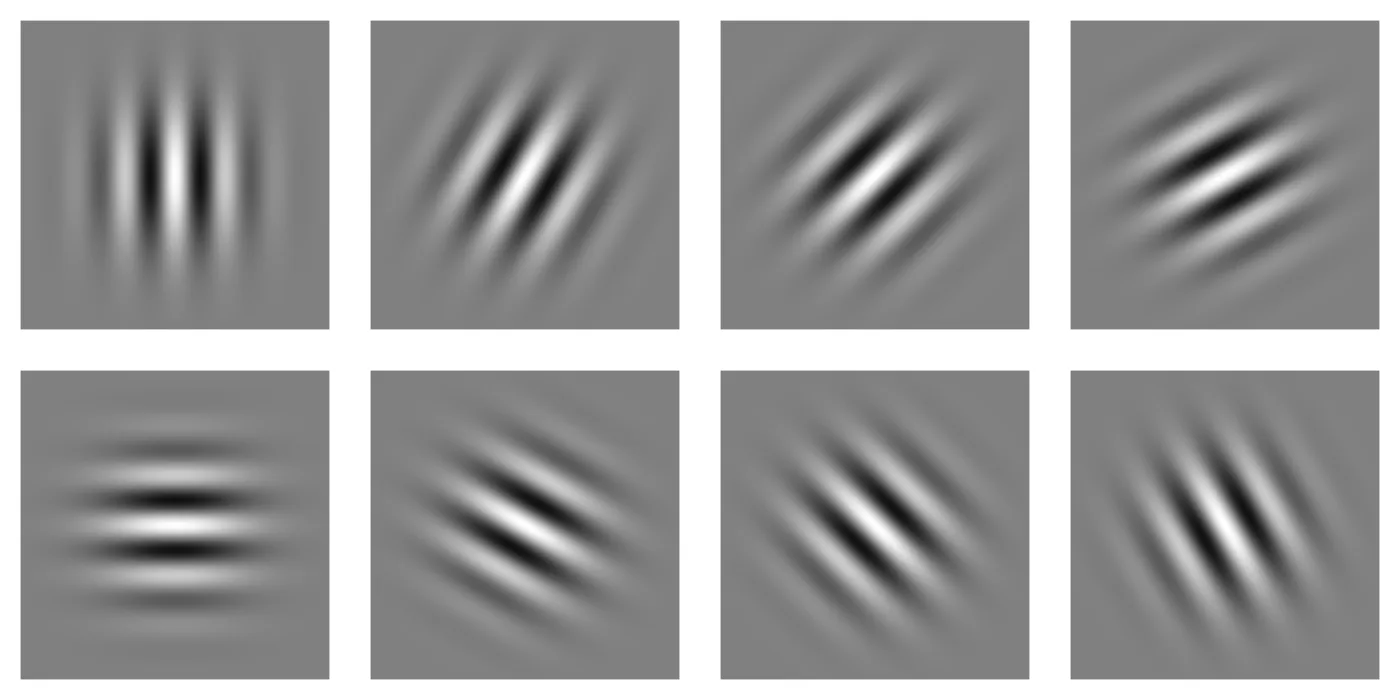
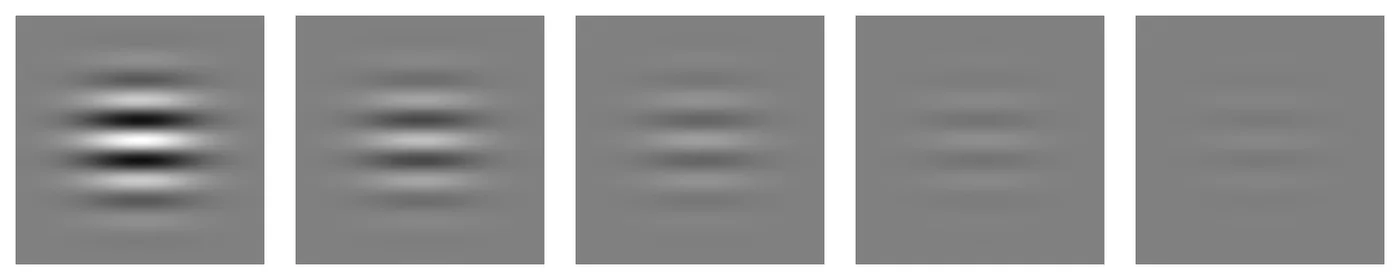
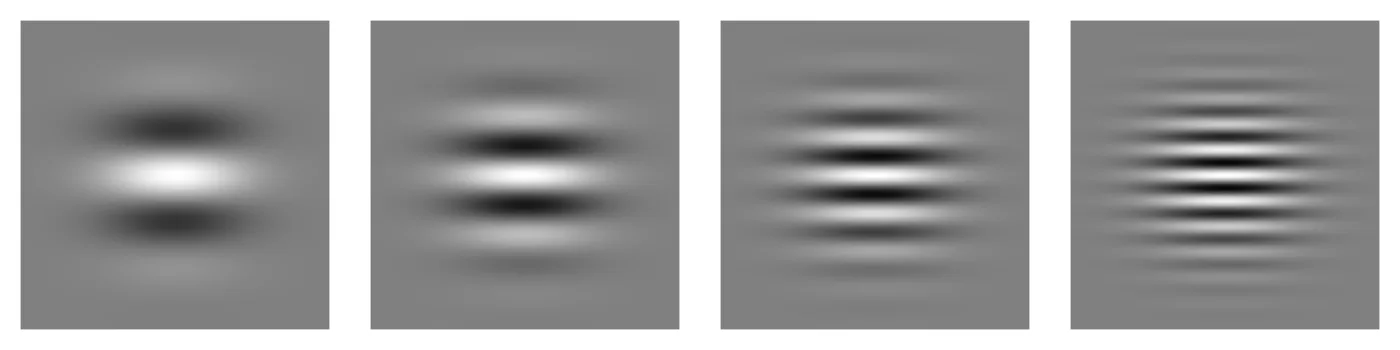
You can also download the individual patches as PNG files: 0°, 30°, 45°, 60°, 90°, 120°, 135°, 150°; contrast 100%, 50%, 25%, 12%, 6%; frequency 3, 5, 8, 12 cycles.

















How the patches were generated
A Gabor patch is a sine-wave grating multiplied by a Gaussian envelope, which is why the stripes fade smoothly into the background instead of ending at a hard edge. Each pixel's brightness is:
L(x, y) = 128 + 127 · c · exp(−(x² + y²) / 2σ²) · cos(2π x′ / λ)
where c is contrast (0 to 1), σ sets how quickly the patch fades (16% of the patch width here), λ is the wavelength of the stripes, and x′ is the horizontal coordinate rotated by the orientation angle. The background gray is the mean luminance, so a patch at 0% contrast disappears into it. If you want to change any of these values live, the interactive Gabor patch generator renders them in the browser.
How to use the sheets
- Print at 100%. Turn off "fit to page" so the patches keep their size. Matte paper reduces glare. A laser printer keeps the gray levels more even than an inkjet.
- Orientation task. Cut out the orientation patches, mix them, and ask which one is tilted differently from the rest, or sort them by angle. Move farther away to make it harder.
- Contrast demonstration. View the contrast sheet from across the room and note where the faintest patch you can still see falls; move closer and it reappears. That threshold is what the research literature calls contrast sensitivity.
- Spatial frequency demonstration. The finest patch blurs into a plain gray blob first as you back away. That is the same thing happening when small print stops resolving.
- Teaching. The sheets pair well with the explainer on what Gabor patches are for a psychology, neuroscience, or optics class.
What printed patches cannot do
The perceptual-learning studies that made Gabor patches famous did not use paper. They used calibrated displays that can show contrasts of a few percent or less, precisely timed presentations, and adaptive difficulty that tracks each person's threshold trial by trial. Print cannot reproduce any of that: paper and ink cannot render very low contrasts accurately, ambient light changes the effective contrast, and there is no adaptive staircase. Treat these sheets as a demonstration and teaching aid, not as a training program, and do not expect them to change your eyesight. The research review explains what the studies actually measured and their limitations.
If you want the on-screen, adaptive version of the task, the free browser demos (orientation, contrast, spatial frequency) run the same idea with real-time difficulty adjustment, and Get Visionary turns it into a guided daily plan on iPhone and iPad.
Für deutschsprachige Nutzer · 日本語をお使いの方へ
Deutsch: Die PDF-Vorlagen enthalten keinen Text und lassen sich direkt ausdrucken. Was Gabor-Muster sind und was die Forschung dazu sagt, erklärt die deutsche Seite zu Gabor-Mustern.
日本語: このPDFは文字を含まない印刷用ガボールパッチのシートです(方位・コントラスト・空間周波数の3枚)。そのまま印刷してお使いいただけます。ガボールパッチの解説は日本語ページをご覧ください。印刷物は視力を回復させるものではなく、教育・デモ用です。
License
The patches and sheets are released by Numentio, LLC for free personal, educational, and clinical-education use. You may print and share them; please link back to this page if you republish them online. They are not licensed for resale.
Frequently asked questions
Do printed Gabor patches improve your vision?
What are Gabor patches?
How far away should I view them?
Can I use these for a Gabor eye exercise book routine?
Can I use the sheets in my classroom or clinic?
Keep reading
What are Gabor patches?
Research, uses, and limits, in plain language.
Interactive Gabor patch generator
Change orientation, contrast, and frequency live in your browser.
Orientation training demo
The classic which-one-is-tilted task with adaptive difficulty.
Gabor patch training and presbyopia
What the studies actually found.